Beyond Comfort Zones: How to Challenge Yourself for Continuous Growth
In today’s rapidly evolving world, staying within what feels safe and familiar often prevents us from reaching our full potential. The concept of a comfort zone represents the psychological state where we feel at ease and in control, experiencing minimal stress and anxiety.
While this state offers temporary security, it simultaneously acts as an invisible barrier that can hold you back from experiencing life’s richest opportunities.

Personal growth rarely happens within these boundaries of familiarity; it thrives in the spaces where we challenge ourselves to try something new and venture into the unknown.
Understanding Your Comfort Zone
The comfort zone isn’t merely a physical space but a psychological state where activities and behaviors fit within a routine that minimizes stress and risk. It’s where one’s comfort is prioritized over growth opportunities. While staying in your comfort zone provides a sense of security, it often leads to stagnation.
Recognizing when you’re within your comfort zone becomes crucial because true growth happens at the edge of your comfort zone, where challenge and skill meet. “Comfort zone” means different things to different people, but universally, it represents the familiar territory where we feel safe yet potentially limited.
Benefits of Leaving the Comfort Zone
Venturing beyond your established routines offers numerous advantages for personal and professional growth.
- You develop adaptability and resilience, essential in our ever-changing world.
- You gain creativity and improved problem-solving skills as you engage with unfamiliar environments.
- You increase self-confidence by proving to yourself that you can navigate new challenges.
- New experiences lead to a deeper understanding of the world around you.
- By stepping out, you open yourself to opportunities and connections you would not have encountered otherwise.
Research from Cornell University found that instructing participants to seek discomfort increased their progress and learning outcomes in goal-oriented tasks. Cornell Chronicle
Step Outside Your Comfort Zone

To step outside your comfort zone effectively, adopt a plan rather than jumping blindly.
Identify Areas Where You Play It Safe
- List routines you follow because they feel easy.
- Recognise where you avoid risks or new experiences.
Take Small, Manageable Steps
- Try a slightly bigger challenge than usual, for example, speak up in a small group instead of avoiding it.
- Schedule one “stretch” activity per week.
Maintain Your Base of Security
You don’t have to abandon everything you know; instead, you expand your capabilities while keeping your stability intact.
Leave Your Comfort Zone With Purpose
Leaving your comfort zone with a sense of purpose ensures the effort leads somewhere meaningful. Alignment with your values and goals transforms challenges into stepping stones.
- Focus on activities that support your vision.
- Choose experiments that reveal what you want, not just what you fear.
- Recognise that discomfort is temporary; growth is permanent.
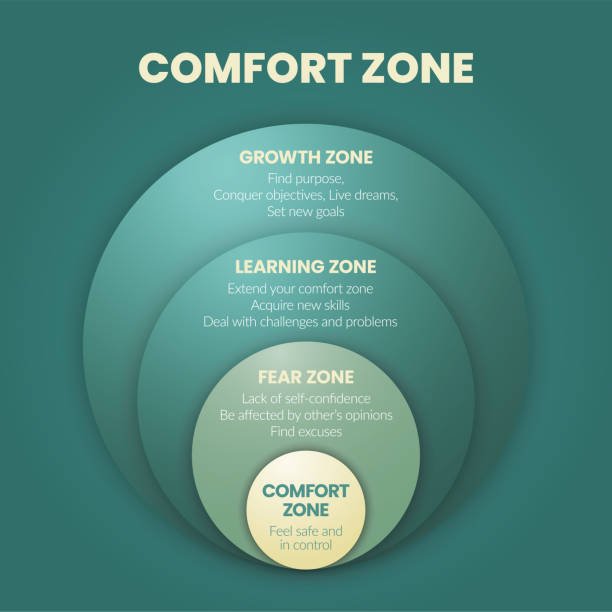
Growth Zone vs Fear Zone
Beyond the comfort zone lies distinct emotional territories:
- Fear Zone: Excuses, low confidence, overthinking.
- Learning Zone: You take on challenges, build skills, expand perspectives.
- Growth Zone: You set new goals, live with purpose, and operate confidently.
Understanding these zones helps you navigate your journey from comfort to growth.
Growth Mindset: The Key to Progress

Developing a growth mindset changes how you approach challenge. Instead of avoiding difficulty, you embrace it as an opportunity to improve. Your abilities are not fixed through effort and persistence; you can expand them.
A growth mindset means you see setbacks as feedback, not failure. The process becomes as important as the outcome.
Embrace New Challenges

Welcoming new challenges means you view unfamiliar situations as opportunities instead of threats. Whether you learn a new hobby, start a different career path, or move to a new city, each challenge stretches your capabilities.
New experiences expose you to skills and perspectives you may never discover otherwise. As you embrace them, your comfort zone naturally expands and future challenges feel less intimidating.
New Experiences Lead to Personal Growth
New experiences act as catalysts for transformation.
- Engaging in novel activities activates different neural pathways and supports more complex thinking.
- Every new attempt, success or not, builds experience and knowledge.
- Over time, accumulated experiences accelerate personal and professional growth, making you more capable and fulfilled.
Beyond Your Comfort Zone: Finding Opportunities

Life is full of chances to step outside your familiar territory — if you’re willing to recognise them.
- Everyday interactions, new projects, relationships, and even hobbies can be growth opportunities.
- Reframing stepping into the unknown as exploration rather than risk helps reduce fear.
- The world outside your comfort zone often contains the very experiences that fuel success and evolution.
New Skill Acquisition as Growth Strategy
Learning a new skill is one of the most direct routes to personal growth.
- Whether it’s coding, cooking, or learning an instrument, new skills expand your mental capacity.
- Skill learning teaches perseverance, patience, and adaptability, qualities that transfer across life.
- Setting aside regular time for growth ensures continuous development.
Small incremental steps in learning compound into significant capabilities.
Overcoming Setbacks on Your Growth Journey

The path out of your comfort zone involves obstacles and setbacks.
- How you respond to challenges determines whether they become stepping stones or stumbling blocks.
- Use setbacks as feedback: what worked, what didn’t, and how to adjust.
- Resilience grows each time you face difficulty instead of retreating to safety.
Growth and progress require persistence through discomfort and uncertainty.
What Can Hold You Back
Several factors can prevent you from venturing beyond familiar territory.
- Fear of failure stops many from trying something new.
- Worrying about others’ opinions can keep you rooted in place.
- Past negative experiences may form mental barriers that discourage exploration.
By identifying what holds you back, you can address those barriers head-on and start moving forward.
Tips to Help You Step Outside
Practical strategies make the transition smoother and more sustainable.
- Start with baby steps rather than giant leaps.
- Make yourself accountable by sharing your goals with someone.
- Celebrate every progress, no matter how small.
- Schedule regular reflection to recognise growth and plan next challenges.
- Mix growth activities across life areas (career, personal, social) for balance and breadth.
Achieving Personal Growth Through Consistent Challenges
Growth comes from regular exposure to challenges, not just occasional bursts.
- Set progressively more demanding goals to prevent a plateau.
- Track your growth journey to visualise progress and stay motivated.
- The compound effect of small, consistent challenges leads to a more confident, adaptive self.
The key is steady progress, not sporadic leaps.
Conclusion
The journey outside of your comfort zone represents the path to fulfilment and continuous development. While comfort provides temporary ease, the richest experiences and most significant accomplishments lie in territories that initially feel unfamiliar.
By understanding the dynamics of comfort, fear, learning, and growth zones, developing a growth mindset, and systematically challenging yourself through new experiences and skills, you create a life defined by expansion rather than limitation.
Remember: venturing beyond your comfort zone is not about reckless risk-taking but about thoughtful stretching of your capabilities in service of becoming your best self. With each challenge embraced, your comfort zone expands, and what once felt impossible becomes your new normal.